
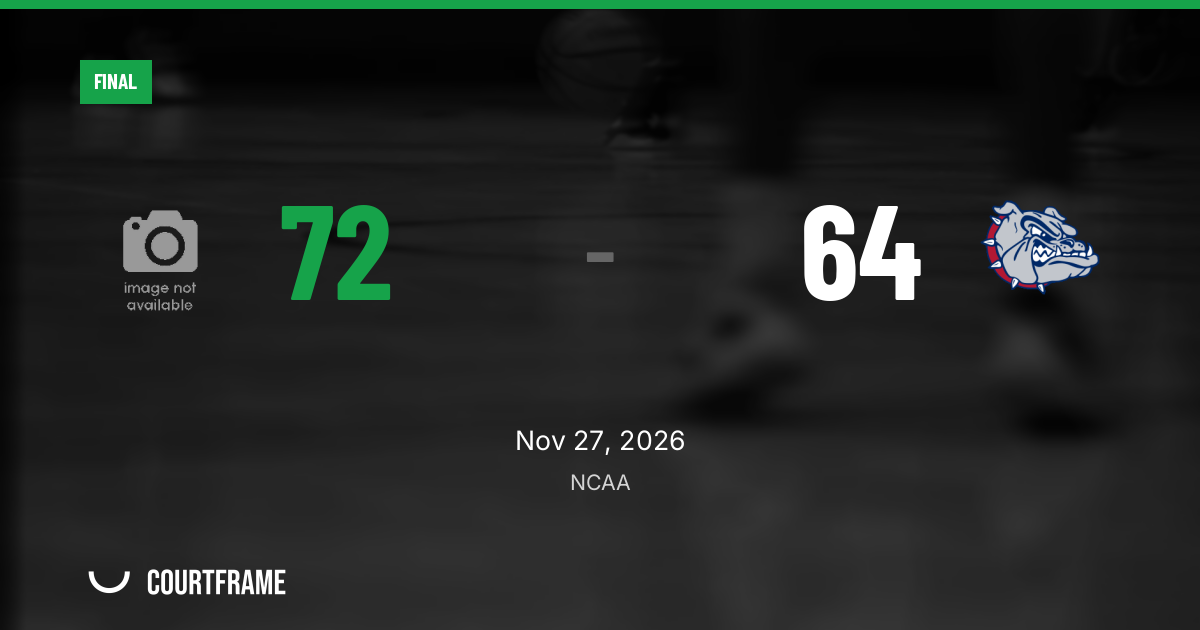
Baylor beat Gonzaga 72-64 on November 27, improving to 5-1 and holding a Gonzaga team that entered averaging 88.4 points to 64. Baylor, which came in averaging 88.3 points, also finished below its scoring average, but the Bears controlled the game through defense and pace rather than volume scoring.
The result ran against the pregame market lean, which gave Gonzaga a 59.6 percent implied probability compared with Baylor’s 40.4 percent. It aligned more closely with the CourtFrame Power Index matchup: Baylor entered at 72.64, ranked 58th, with a 7.8 trend, while Gonzaga entered at 69.65, ranked 69th, with a minus-0.3 trend. Baylor’s three-point CPI edge translated into an eight-point win.
Baylor’s defense shaped the game
The defining number was Gonzaga’s 64 points. The Bulldogs had averaged 88.4 points through a 4-1 start, but Baylor kept them 24.4 points under that mark. Gonzaga also entered with an 81-point average away from home, and the Bears still held the Bulldogs 17 points below that road split.
Baylor did not need to match its usual scoring profile to win. The Bears entered averaging 88.3 points overall and 92.4 points in their home split, but 72 was enough because Gonzaga never reached its normal offensive range. The game finished at 136 total points, well below the totals clustered from 150.5 to 159.5 before tipoff.
Home form outweighed Gonzaga’s road profile
Baylor’s home split remained perfect at 5-0, and the Bears’ average of 92.4 points in that split had framed the matchup as a test of whether Gonzaga could keep Baylor out of its preferred scoring environment. Gonzaga entered 2-1 away from home with an 81-point average, but Baylor’s defense pulled the Bulldogs below both their overall and road scoring baselines.
The Bears’ 72 points were not a high-end offensive output by their own early-season standard, but the game state favored Baylor once Gonzaga’s offense was forced into a lower-scoring contest. Baylor’s margin came from suppressing the Bulldogs, not from exceeding its own scoring trend.
Rest and availability mattered at the margins
Neither team had significant injuries reported, so the matchup was not shaped by major absences. The schedule context was less even. Baylor entered with two days of rest and one game in the previous seven days, while Gonzaga played on one day of rest in a back-to-back situation with one game in the previous seven days.
That difference did not guarantee the result, but it fit the way the game unfolded. Gonzaga’s offense, usually operating near 90 points per game, never found enough scoring to pressure Baylor late. Baylor’s ability to keep the game in the 70s and 60s made the rest edge more relevant than either team’s season-long scoring average.
What the result says
Baylor moved to 5-1 with a win that strengthened its early profile because it came against a 4-1 Gonzaga team and contradicted the pregame market expectation. The Bears also backed up their stronger CPI position, extending a positive trend while Gonzaga’s slight negative trend carried into the result.
For Gonzaga, the concern is not the final margin alone. It is that a team averaging 88.4 points produced only 64 in a matchup with no significant injury limitations. For Baylor, the takeaway is clear: the Bears can win without reaching their usual scoring level when their defense controls the opponent’s ceiling.