

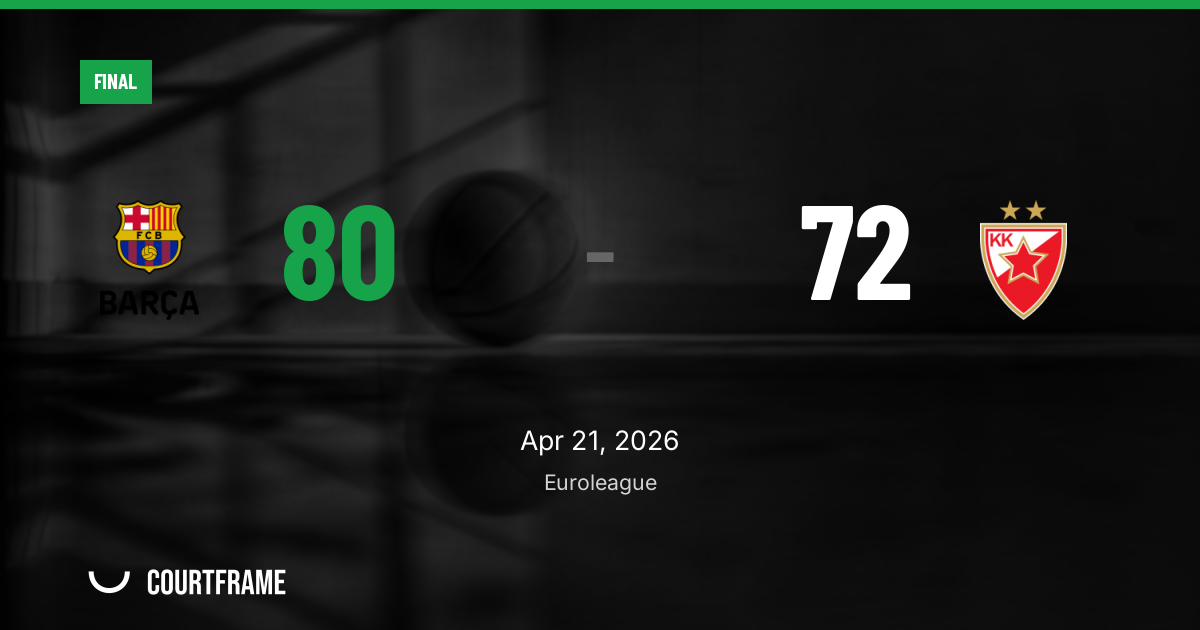
Barcelona struck first, defended the middle, and lived on the arc — the exact formula the pregame indicators suggested — to beat Crvena zvezda 80-72 on April 21, 2026 at Palau Blaugrana.
The game turned early. Barcelona’s 29-point first quarter created immediate separation, and even when Crvena zvezda dragged the pace down with a 12-point second quarter from the home side, the visitors never found the offensive continuity to flip the script. Barcelona won each of the other three periods and finished the night with 13 made threes on 28 attempts, a clean expression of its high three-point rate profile.
How Barcelona won it
1) The first-quarter punch held up
Barcelona’s 29-21 opening quarter was the game’s most decisive stretch. Crvena zvezda answered with its best defensive segment in the second (holding Barcelona to 18), but the hole mattered: at halftime, Barcelona was still up 47-36.
From there, the game tightened without ever fully tilting. Crvena zvezda won the fourth 21-17, yet Barcelona’s earlier work — and a steady enough close — kept the finish controlled.
2) Three-point math and spacing
Barcelona’s perimeter volume was the separator. The home side went 13-for-28 from three, pairing shot-making with a shot diet that matched its recent trend (a three-point rate listed at 65.9 in the provided sample). Crvena zvezda hit 10-for-26 from deep, but couldn’t match the raw makes, and the rest of the offense didn’t compensate.
3) Turnovers and disruption tilted possessions
Barcelona won the possession battle at the margins: eight steals and 10 turnovers versus Crvena zvezda’s four steals and 14 turnovers. In a game that ended with an eight-point margin, those extra empty trips mattered — especially with both teams getting plenty of their scoring from the same area of the floor (the three-point line).
What the box score says about the matchup
Barcelona’s defense traveled — and it looked like the recent sample
Barcelona’s defensive profile entering the game was strong in the provided advanced snapshot (86 defensive rating across the analyzed stretch). The flow of this one reflected that: Crvena zvezda managed 72 points and only nine assists as a team, a sign Barcelona was able to reduce easy creation and force more isolated, lower-connectivity possessions.
Crvena zvezda’s ball movement didn’t translate
In the provided 10-game sample, Crvena zvezda carried an extremely high assist rate (91.4) and averaged 20.1 assists. That didn’t show up here: nine assists is a sharp drop from its listed norm, and it paired with 14 turnovers — a combination that makes it difficult to keep pace on the road, even with decent three-point output.
Rebounding wasn’t enough to compensate
Crvena zvezda finished with 34 rebounds to Barcelona’s 33, consistent with its stronger rebounding percentage in the provided sample (53.0 vs Barcelona’s 49.1). But the edge was slim and didn’t offset the turnover gap and the difference in made threes.
Context: why the result fit the pregame picture
This matchup came in with both teams at 21-17, but the broader signals leaned Barcelona: the market implied a 62.9% home win probability, and the CPI matchup differential favored Barcelona (68.25 vs 30.98). Barcelona also entered with a positive net rating in the provided sample (+12.5), while Crvena zvezda’s was negative (-6.7).
There were no significant injuries reported for either side, and both clubs were on similar rest (Barcelona: four days; Crvena zvezda: five). With availability stable, this game largely became a strengths-vs-weaknesses test — and Barcelona’s defensive resistance plus perimeter volume won out.
By the numbers
Final: Barcelona 80, Crvena zvezda 72
Quarter scores: Barcelona 29-18-16-17; Crvena zvezda 21-12-18-21
Barcelona team line (as provided): 17/38 FG, 13/28 3PT, 33 REB, 16 AST, 10 TO, 8 STL, 3 BLK
Crvena zvezda team line (as provided): 13/32 FG, 10/26 3PT, 34 REB, 9 AST, 14 TO, 4 STL, 1 BLK