
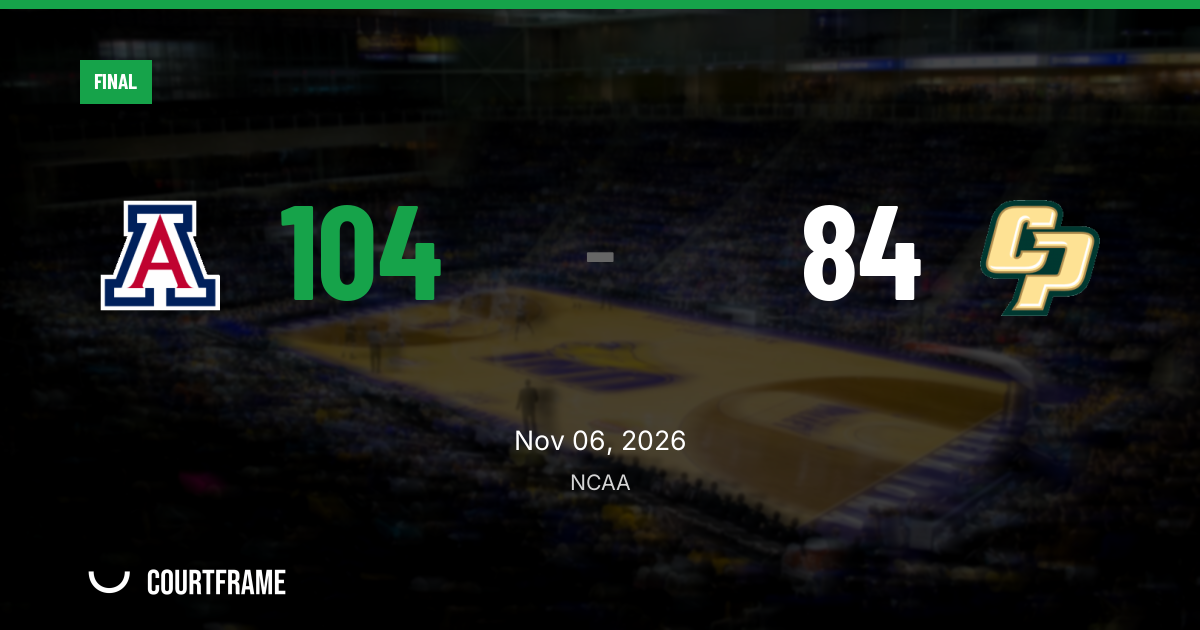
Arizona moved to 1-1 with a 104-84 win over Cal Poly on November 6, 2026, turning a high-possession scoring environment into its first victory of the 2026-27 season. Cal Poly entered at 1-0 and reached 84 points, but Arizona’s offensive volume and early separation defined the night.
The Wildcats led 59-41 at halftime, a margin that shaped the rest of the game. Cal Poly scored 43 points after halftime, but Arizona added 45 of its own, preventing the Mustangs from turning improved second-half offense into a meaningful comeback.
Arizona’s first-half offense decided the game
Arizona’s 59-point first half was the central factor in the result. The Wildcats entered averaging 75 points through one game, then surpassed that mark well before the final stretch and finished with 104 points.
That early offensive surge gave Arizona an 18-point halftime cushion. The Wildcats did not need to expand the margin significantly after the break because their first-half production had already forced Cal Poly into a game state that required sustained stops and efficient scoring on nearly every trip.
Cal Poly’s 84 points were enough to reflect a productive offensive night, especially after a 43-point second half. The issue was defensive resistance. Arizona matched Cal Poly’s second-half output closely while protecting the advantage it built before halftime.
Result ran counter to early-season indicators
The matchup carried unusual early-season context. Cal Poly entered 1-0 with a CourtFrame Power Index of 100.00 and a rank of 20, while Arizona entered 0-1 with a CourtFrame Power Index of 0.00 and a rank of 256. On the court, Arizona reversed that profile by controlling the scoring margin from the opening half.
The market expectation favored Arizona heavily, with an implied win probability of 96.7 percent across three bookmakers. The final result aligned with that pregame view of the matchup, even though the early CourtFrame Power Index snapshot favored Cal Poly by a differential of 100.
Both teams entered on equal rest, with three days off and one game in the previous seven days. Neither team had significant injuries reported, so the outcome was not shaped by a clear availability imbalance.
Cal Poly scored enough to stay competitive, but not enough to pressure Arizona
Cal Poly’s offense produced 41 points before halftime and 43 after halftime, showing consistency across both halves. The Mustangs finished above their 78-point scoring average entering the game, but Arizona’s 104 points created a margin that Cal Poly’s offense could not offset.
The lack of recent head-to-head history made this an early-season measuring point rather than a continuation of an established matchup trend. Arizona’s home split now includes a 104-point scoring performance, while Cal Poly’s away split includes an 84-point output in defeat.
For Arizona, the win stabilized an 0-1 start and showed a level of offensive force that was not present in its opening scoring average. For Cal Poly, the loss dropped the Mustangs to 1-1 despite a solid scoring total, with the defensive side of the matchup carrying the larger concern.