

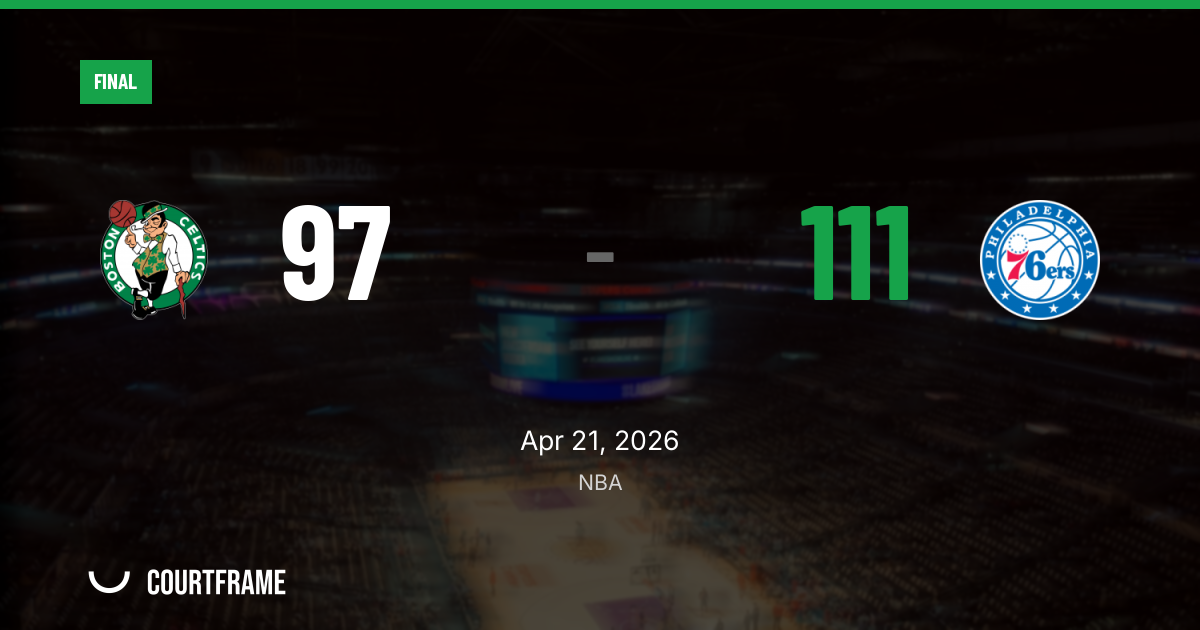
Philadelphia didn’t need Joel Embiid to look like the sharper, more connected team Tuesday night.
The 76ers beat the Boston Celtics 111-97 at TD Garden on April 21, 2026, turning a one-point deficit after the first quarter into a comfortable road win behind a 37-point second quarter and a barrage of 3-pointers (19 made 3s).
How the game swung: one quarter, one shot profile
Boston led 28-25 after one, but the game broke open in the second. Philadelphia won the quarter 37-26, taking a three-point edge into halftime and never letting Boston fully reset.
The difference was the math. The 76ers generated 19 made 3s and paired it with a low-turnover night (9). Boston, meanwhile, leaned heavily on the arc as well (13 made 3s) but couldn’t match the volume or the timing — and the Celtics’ offense faded late, scoring just 20 points in the fourth as Philadelphia closed 27-20.
Possession battle: Philadelphia took care of the ball
In a game without a dominant interior scorer on Philadelphia’s side, the 76ers played a cleaner brand of basketball. They finished with 9 turnovers to Boston’s 13 and added 6 steals to Boston’s 3, creating extra chances without needing to dominate the glass.
Boston actually won the rebounding battle 50-42 and moved the ball well (24 assists), but the Celtics couldn’t turn that into a sustained scoring advantage as the game tightened. Philadelphia’s ability to keep possessions alive through ball security — and cash them in from deep — mattered more than second-chance opportunities.
Three-point variance, but not random
The 76ers’ win aligned with the simplest explanation: shot-making from beyond the arc. Philadelphia hit 19 3s on 39 attempts, a decisive edge over Boston’s 13 makes on 50 attempts. That gap functioned as the game’s offensive separator, especially with Philadelphia taking only 11 free throws (6 made) compared to Boston’s 18 attempts (14 made).
Boston’s approach skewed even more perimeter-heavy, but the efficiency didn’t follow. When the Celtics’ fourth-quarter offense stalled, there wasn’t a reliable fallback to manufacture points at the line or through a steady diet of easy looks.
Pre-game context: this result cut against the indicators
Nearly everything pointed toward Boston: a 56-26 record, strong recent form (WWLWW), and a dominant market lean (home implied probability 86.2%). The Celtics also came in with 2 days rest and just 1 game in the last 7 days, plus a strong home split (18-5, 112.4 average points).
Philadelphia arrived at 45-37, in a skid (WWLLL), with Embiid ruled out — yet played like the team with the clearer plan. In the 10-game sample provided, Boston’s net rating edge (17.6) over Philadelphia (-1.7) suggested separation; on the floor, the 76ers created it through shot profile and execution, not star power.
Closing note
Boston won the first quarter and the rebounding battle. Philadelphia won the game where it’s easiest to lose it on the road: the turnover margin and the 3-point line. Without Embiid, the 76ers leaned into spacing and decision-making — and left TD Garden with a 14-point statement.