

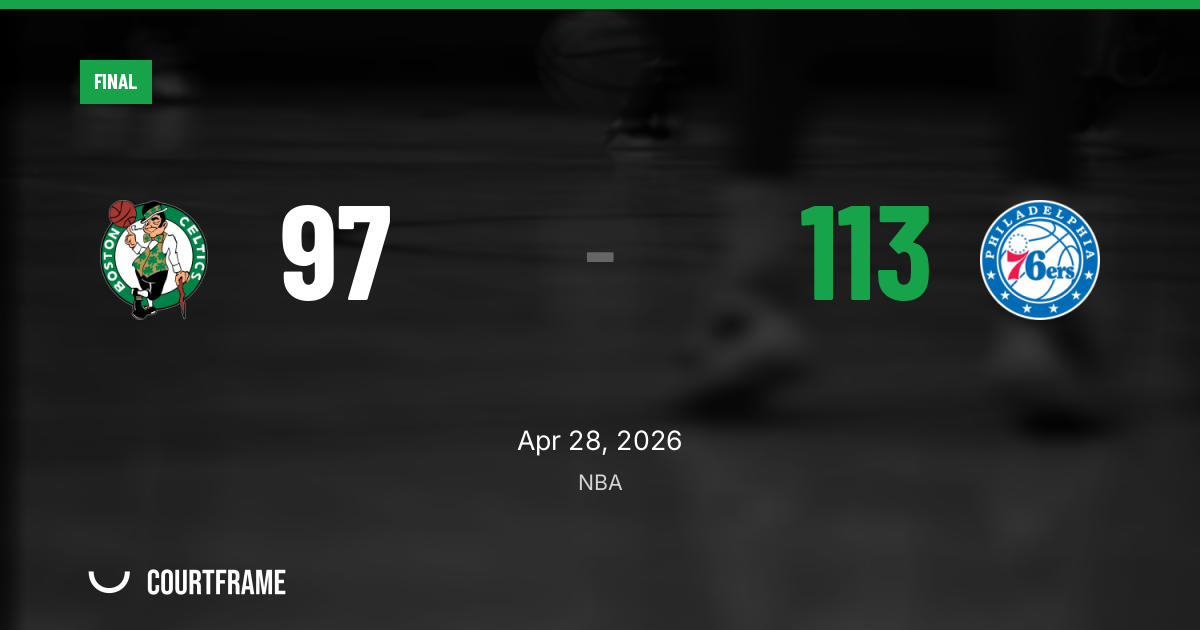
Philadelphia came to TD Garden facing elimination and left with the series tied.
The 76ers beat the Celtics 113-97 on April 28, turning Game 6 of their first-round playoff series with a ruthless fourth quarter. Boston led after the first quarter, scored 57 points by halftime and still entered the final period within reach. Then the game collapsed on the Celtics: Philadelphia closed with a 28-11 fourth quarter and forced a Game 7 in a series Boston once led 3-2.
The result cut directly against the pregame market. Boston carried an 80.9 percent implied win probability across 11 bookmakers, owned the stronger season profile at 56-26 and entered with a major CourtFrame Performance Index edge — 91.17, ranked No. 2, compared with Philadelphia’s 52.27, ranked No. 18. None of it mattered once the 76ers found separation late.
Fourth Quarter Decides the Night
Boston’s path looked stable through three quarters. The Celtics led 23-21 after the first, then produced their best offensive stretch in the second quarter with 34 points. Philadelphia answered with 29 in the second and then seized momentum with a 35-point third quarter, trimming the game into a late-possession fight.
The fourth quarter was not a fight. It was a Philadelphia takeover.
The 76ers scored 28 in the final period while holding Boston to 11, the kind of closing split that overwhelms every earlier edge. For a Celtics team that entered with a 75 percent home win rate in its split profile and an average of 111.8 points at home, the final frame was the defining failure: not enough shot quality, not enough pressure, not enough late-game execution.
Philadelphia Wins the Efficiency Battle
The box score profile showed how Philadelphia survived on the road. The 76ers finished with 24 assists and only nine turnovers, keeping the game clean against a Boston team that had averaged 6.6 steals over its previous 10 analyzed games. In an elimination setting, that ball security mattered.
Boston had 25 assists and 12 turnovers, a respectable distribution profile on the surface, but the Celtics’ shot mix did not translate into enough scoring pressure. They went 11-for-39 from 3-point range and 14-for-23 at the free-throw line. Philadelphia, meanwhile, hit 15 3s and converted 20 of 22 free throws, creating the cleaner scoring margin without needing a major rebounding advantage.
The Celtics won the glass 49-41, but the 76ers offset that with better perimeter production, stronger free-throw accuracy and fewer wasted possessions. Philadelphia also added three blocks while Boston finished with none, a small but relevant indicator of how the 76ers affected the game defensively near the rim.
Pre-Game Indicators Favored Boston — Until They Didn’t
Boston entered with clear statistical advantages. Over the previous 10 analyzed games, the Celtics carried a 124.1 offensive rating, 112.4 defensive rating and plus-11.7 net rating. Philadelphia’s comparable profile was more volatile: 110.8 offensive rating, 114.3 defensive rating and minus-3.5 net rating.
The Celtics also had the more efficient shooting indicators in that sample, including a 78.8 true shooting percentage, 76.5 effective field goal percentage and 38 percent from 3. Philadelphia came in at 65.3 true shooting, 61.1 effective field goal percentage and 33.6 percent from deep.
Game 6 flipped those expectations because Philadelphia’s execution sharpened under pressure. The 76ers protected the ball, won the 3-point volume result and punished Boston at the line. That combination was enough to overcome the Celtics’ home-court profile and their pregame analytical edge.
No Injury Excuses, Equal Rest
Neither team entered with significant injuries reported, and both played on two days’ rest with three games in the previous seven days. This was not a fatigue imbalance or availability-driven outcome. Philadelphia simply handled the leverage moments better.
That makes the result more consequential. Boston had the healthier profile, the superior record, the home floor and the chance to close. Philadelphia had the pressure of elimination and responded with its best stretch when the Celtics were at their worst.
Series Heads to Game 7
The 76ers’ win turns the first-round matchup into a one-game season. Boston still owns the broader indicators — stronger record, stronger CPI, stronger net rating and the deeper home résumé — but Game 6 exposed the danger in assuming those edges will carry late.
Philadelphia’s stars entered the series with a high-end scoring core led by Joel Embiid, Tyrese Maxey and Paul George. Boston countered with Jaylen Brown, Jayson Tatum, Anfernee Simons, Payton Pritchard and Derrick White. In Game 6, the deciding layer was not the names. It was possession discipline and fourth-quarter force.
The Celtics had a chance to finish the series at TD Garden. The 76ers took it away. Now the matchup goes to Game 7 with Philadelphia alive and Boston left to answer for an 11-point fourth quarter that changed the series.